Driving theory questions
This is an old question that is no longer in use.
Images may be missing and the information may be dated.
You put air in your tyres at a petrol station. Which option is true?
“Is it not possible for the tyre to explode?
No. To do this, you would have to pump in more than 13–15 kg (bar) – more than five times the normal tyre pressure of a private car. It is not possible to get this much air in, as a normal compressor cannot provide this type of pressure. At approximately 6–7 kg (bar) the rim may rupture – but even this pressure is difficult to reach with regular pumping devices.” (Swedish Transport Administration)
As the question relates to a petrol station, and you are not given any specific information about the pump, you should assume that it is a regular model (i.e. not powerful enough to make the tyre explode).

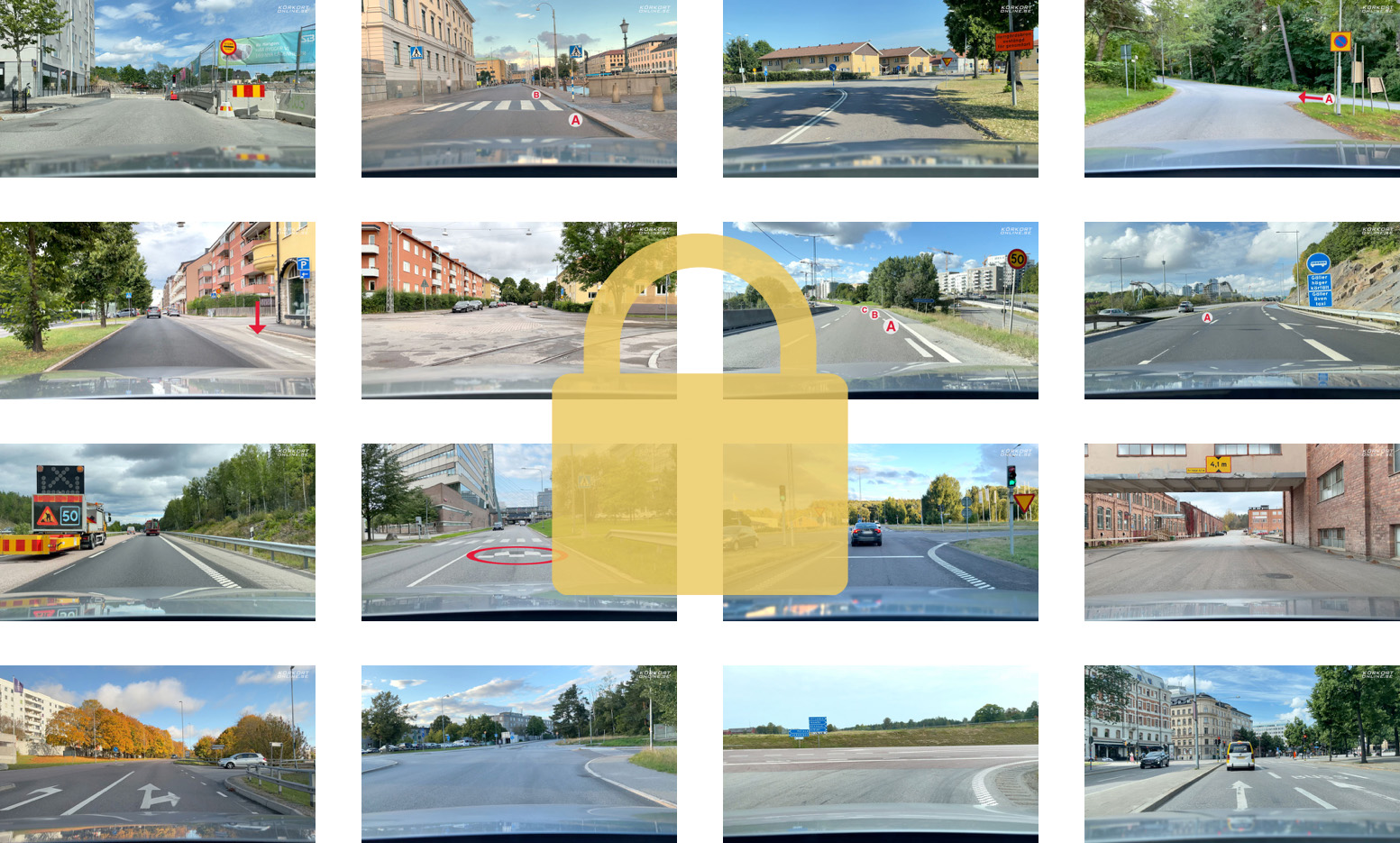
This is an example of one of the driving theory questions at Körtkortonline.se.
There is also a driving licence book online (2026).
More examples of theory questions:
- How much of the fuel used for road transports in Sweden comes from fossil sources?
- Which amount of carbon dioxide emissions could be avoided annually in Sweden if everyone kept to the speed limits?
- What is true regarding the emissions of sulphur dioxide?
- What is true when it comes to the development of the air quality in built-up areas since the early 1990s?
- You are travelling at 30 km/h. How long will the braking distance be, if it is 41 metres at 60 km/h?
- You are driving a heavy cargo for a friend. Before you reach their house, you see this sign. What rule applies?
- Is it possible for an additional extension panel to depict a single arrow pointing upwards?
- You arrive at this situation. What should your reasoning be?
- The grey car is turning left. Is the driver obligated to use their indicator?
- How much better, in terms of traffic safety, is it to use a handsfree rather than holding your mobile in one hand?
- You are driving on to a motorway. What rule applies?
- Which statement is true regarding accidents caused by tiredness late at night?
- Study the picture. Which of the following is true?
- Which statement is true regarding brake fluid?
- You are driving at 90 km/h. How many metres does the car travel in 4 seconds?
- How many metres per second (m/s) is 110 kilometres per hour (km/h)?
- How many kilometres per hour (km/h) is 14 metres per second (m/s)?
- Which statement is true regarding pedestrians and pedestrian crossings?
- You are driving the vehicle from which the pictures are taken. In which situation or situations are you obligated to give way to traffic coming from the right?
- You are driving the vehicle from which the pictures are taken. In which situations do you have to give way to all intersecting cars?
Category:
- Driving theory questions: Vehicle
- Driving theory questions: Environment
- Driving theory questions: Traffic safety
- Driving theory questions: Traffic regulations
- Driving theory questions: Individual circumstances
- Driving theory questions: Road signs