
Driving licence exam
Which statement is true regarding the amber traffic signal?
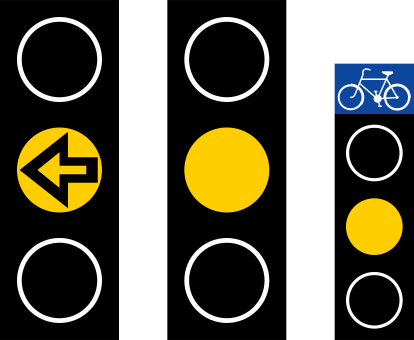
Amber (SIG4)
”Stop. A vehicle may not pass the stop line or, if there is no such line, the signal unless it has come so far when the signal changes from green to amber that it cannot stop without risk.”
If you are driving at 50 km/h and it changes from green to amber when you are three metres from the lights, it would be impossible to stop in time. Panic braking can cause a very dangerous traffic situation.
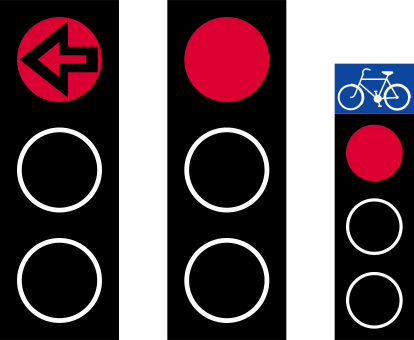
Red (SIG1)
”Stop. A vehicle may not pass the stop line or, in the absence of such, the signal. A signal with an arrow outline only applies to the direction or directions indicated by the arrow.”
They therefore do not have exactly the same meaning.
This is an example of one of the driving theory questions at Körtkortonline.se. There are questions in two languages: English mock test, Swedish mock test
More examples of theory questions:
- What does this road sign combination mean?
- Is defensive driving good?
- You are driving the car from which the picture is taken and intend to turn right. Are you allowed to pass the white car?
- The picture is taken from the car you are driving. Who should stop and give way according to the regulations?
- Why is it advisable to drive with a sideways safety clearance of 1 metre to cars parked along the road?
- Should you use your indicator when pulling out from the curb onto the road (for example, from a parking spot)?
- Which statement is true regarding children in traffic?
- What hazard should you be particularly aware of in this situation?
- Which right of way rule generally applies within a parking area?
- How do the right of way rules work in an open area without signs?
- Can the right-hand rule apply in this situation?
- What is the rule when you are driving on a priority road?
- Is it normal for a priority road sign to be located after a junction?
- You are driving the car from which the picture is taken and you have just entered the road after having pulled out from a property. The priority road sign in the picture is the first you see. Which option is true?
- You are driving the blue car. Where should you stop in relation to the stop line?
- What does the exit rule entail?
- When must you clear a path for an emergency vehicle?
- You are driving the car from which the picture is taken. How should you act with the ambulance in mind?
- The maximum permitted speed is 70 km/h and your car gets a puncture on the right front tyre. Do you have to put out a warning triangle if you stop at A to change to a temporary spare wheel?
- You are driving the car from which the picture is taken. Are you allowed to pass on the right side of the white car that is turning off directly left into the gravel road?
Category:
- Driving licence exam: Vehicle
- Driving licence exam: Environment
- Driving licence exam: Traffic safety
- Driving licence exam: Traffic regulations
- Driving licence exam: Individual circumstances
- Driving licence exam: Road signs
Full access, 1000 questions

- Account with all 1000 questions.
- Unlimited tests during your access period.
- Theory insights and test insights