Theory exam
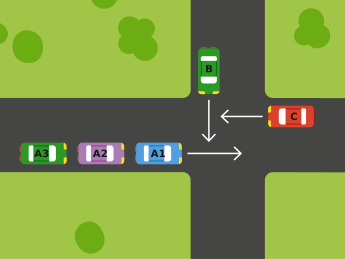
The vehicles are travelling in the direction of the arrows. You are driving vehicle B. How should you act?
The options are not shown, since this is one of the 1000 paid questions.
Buy all 1000 questions now
As there are no road signs or traffic signals, the right-hand rule applies. According to the right-hand rule you should only give way to A, as they are coming from your right. However, a strict insistence on the rules alone is not ideal. According to the curriculum for a category B licence, you must display “good judgement when interacting with other road users.” (Swedish Transport Agency)
The rules give you the “right” to drive after A. However, insisting on this rule is not to show “good judgement when interacting with other road users”, since you are unnecessarily blocking C. While you are waiting for all from A to pass, there is plenty of time for C to go. In addition, it is not safe from a traffic perspective to stand in the middle of the crossing and wait. “When a driver is approaching or entering a junction, they shall adapt their driving so as to not cause an unnecessary hindrance to traffic on the intersecting road should the vehicle be forced to stop at the intersection.” (Swedish Road Traffic Ordinance)
“How should you act” should be read as “which attitude is most appropriate to adopt when entering the situation”. It is best for you go in with the intention to let all A as well as C pass. If this does not work out (i.e. if C stops and waits, clearly indicating that they do not intend to move), it is best to go ahead of C. But you should primarily act according to and hope for the easiest alternative, which is for you to let all A and C pass before you drive on.
This is comparable to the cogwheel principle, which is not regulated by law. Even so, the National Society for Road Safety, FMK and the Swedish Transport Administration recommend using it. (“In the case of entry ramps near built-up areas, the cogwheel principle can be used when there are traffic queues forming.”)
Also note that you are not the one “breaking” the rules, you are simply being generous by waiting.
There is a similar question where it is best to go by the rules. However, how can you know when it is appropriate and when it is inappropriate to deviate from the rules?
Rule of thumb: Does the traffic situation as a whole obviously benefit a lot from us temporarily deviating from the rules? – If the answer is yes, then disregard the rules and do what comes naturally, provided that all those involved appear to be in agreement. After all, you are to show “good judgement when interacting with other road users.” However, if it is not apparent that it is most convenient to temporarily deviate from the rules, or if the common benefit of doing so is small, you should stick to the rules. Doing otherwise could cause confusion, which is not a good thing in traffic.

Körkortonline.se offers driving licence theory tests in English. This is an example of an explanation of a test question.
More examples of explanations:
- The vehicles are driving in the direction of the arrows and you are driving vehicle C. Vehicle B seems to be taking the initiative to go first. How should you act?
- According to the markers, on which side must you pass?
- Which alternative is true?
- Which statement is true at the place indicated by the red arrow?
- Are you permitted to park at the red arrow?
- You intend to continue straight ahead. Are you permitted to change to the left-hand lane in order to pass the car in front?
- Do you have an obligation to give way to A?
- You have stopped to let a train pass at a guarded railway crossing with gates. When are you allowed to drive on?
- Are you permitted to change to lane A?
- It is 08.50 on a Saturday morning. Are you permitted to change to the right-hand lane, after the junction?
- Both lanes are for traffic in your direction of travel. Which statement is true?
- You are travelling towards a destination that is located to the left. Which statement is true?
- You want to turn around. Are you permitted to perform a U-turn at the point when the video ends?
- What does this signal mean?
- Which alternative is true?
- You are driving a regular passenger car with a light trailer. Are you permitted to pass the prohibitory sign?
- Does the road sign indicate that you have an obligation to give way to vehicles coming from the exit road?
- Today is 19 September. Where are you allowed to park?
- What is true when it comes to a motor vehicle with a broken service brake?
- Do you have an obligation to give way if a vehicle approaches from the right at the junction shown at the end of the video?
Category:
- Theory exam: Vehicle
- Theory exam: Environment
- Theory exam: Traffic safety
- Theory exam: Traffic regulations
- Theory exam: Individual circumstances
- Theory exam: Road signs