
Theory exam

Which signal tells you to reduce your speed?
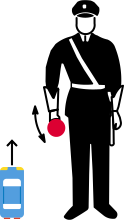


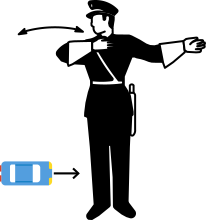
The options are not displayed because this is one of the 1000 paid questions.
Buy all 1000 questions now
Körkortonline.se offers driving licence theory tests in English. This is an example of an explanation of a test question.
More examples of explanations:
- Which signals tell you to reduce your speed?
- Which sign means you must pull over to the side of the road and stop in front of the police vehicle?
- Which sign means you must follow the police vehicle and stop behind it when it stops?
- You are driving at 70 km/h. Are you permitted to increase your speed at the moment the video ends?
- Are you permitted to exit the roundabout by following the red arrow?
- Which statement is true at the coming junction?
- Which statement is true at the coming junction?
- What is true regarding exit ramps from motorways?
- What should you think about as you approach the car that is reversing?
- Which of these statements about speed is correct?
- Where are the warning signs posted in a built-up area?
- You are coming up to a traffic situation where several contradictory directions apply. Which directions should you comply with?
- Which statement is true at this junction?
- You arrive at the site of an accident. What type of injury is most important to attend to first?
- You want to drive towards Järfälla. Where should you position your vehicle while observing your obligation to give way?
- Is it appropriate to reduce your speed and allow the two oncoming cars to pass?
- It is winter and you are about to drive out onto a bridge crossing a watercourse. Should you expect a risk of the road being slippery if the temperature is 0°C?
- Why is parking at the red arrow not permitted?
- When reversing, you have hit and damaged a bicycle in a bicycle stand. What should you do?
- Which statement is true?
Category:
- Theory exam: Vehicle
- Theory exam: Environment
- Theory exam: Traffic safety
- Theory exam: Traffic regulations
- Theory exam: Individual circumstances
- Theory exam: Road signs
Full access, 1000 questions

- Account with all 1000 questions.
- Unlimited tests during your access period.
- Theory insights and test insights